5 Common Furnace Problems (and the Parts Behind Them)
Quick answer
The five furnace problems we see most are a worn blower motor, ignition failure, inducer motor or pressure switch trouble, a failed heat exchanger or burners, and a clogged filter. A well-kept furnace can last 15 to 35 years, but its parts wear out along the way. Most of these are repairs, not replacements.
Why furnaces act up
Your furnace runs through the same steps every time it heats: clear the old gases, light the burners, confirm the flame, then blow warm air through the house. If any part in that chain fails, the whole thing stops. Here's where it usually goes wrong.
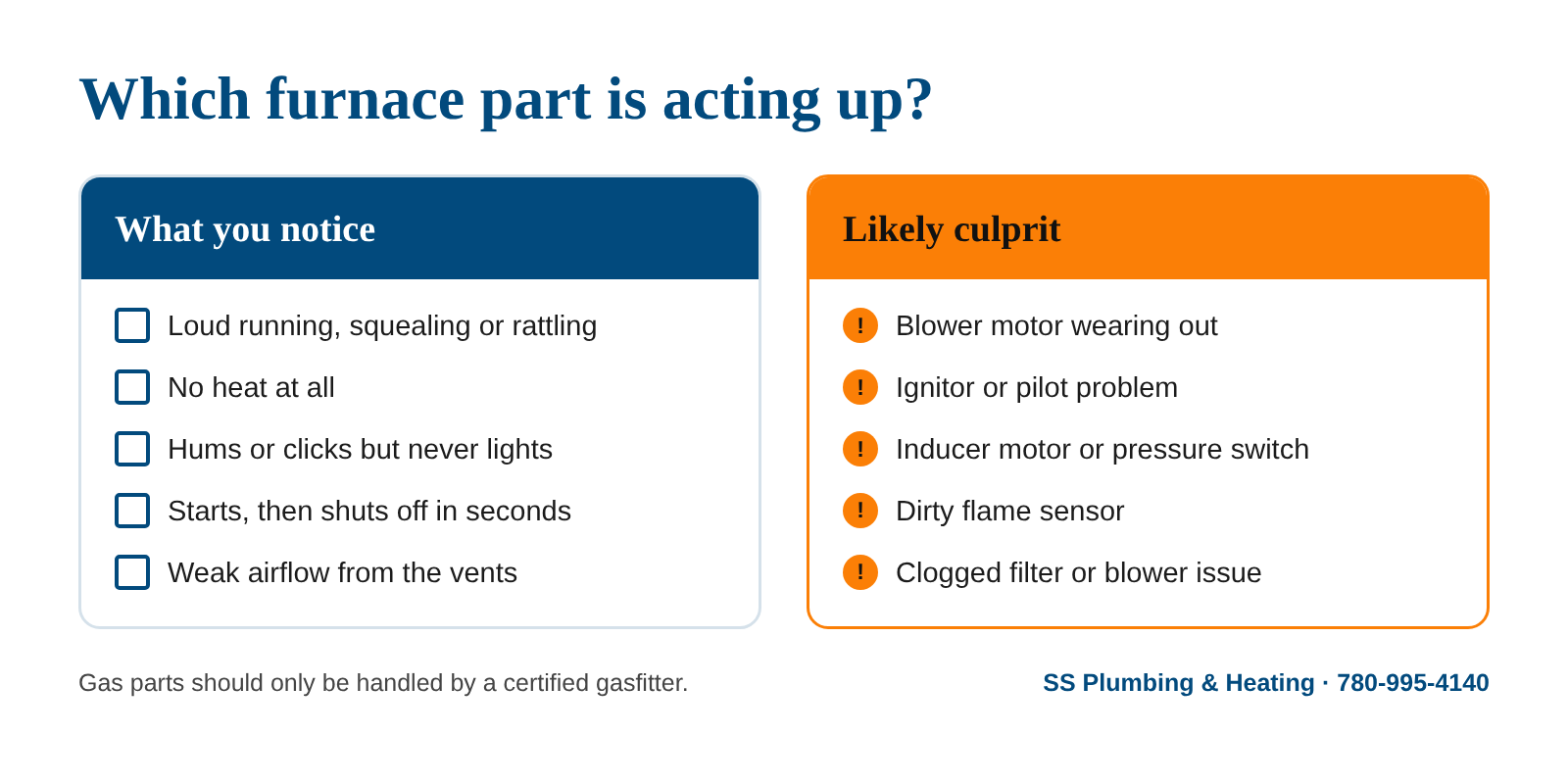
- A worn blower motor. The blower pushes warm air through your vents. When the furnace is dirty, or it's very cold and the furnace runs constantly, the motor and bearings wear out. Watch for a furnace that's getting louder, squealing or rattling when it starts and stops, or weak airflow from the vents.
- Ignition failure. If the burners can't light, there's no heat at all. Older furnaces use a pilot light; newer ones use an electronic ignitor. A flame sensor then confirms the flame. If it's dirty, it can't "see" the flame and shuts the gas off after a few seconds.
- Inducer motor or pressure switch problems. Before lighting, the inducer motor clears leftover combustion gases out through the flue. The pressure switch checks that it's working. If either fails, the furnace may hum or click but never light.
- A failed heat exchanger or burners. The heat exchanger moves heat from the burners into your home's air. A cracked one is serious, because it can let carbon monoxide mix with your air. Burners have no moving parts but still wear out, and they stop working if the gas valve fails.
- A clogged filter. The easiest one to prevent. A clogged filter makes your furnace work much harder, which stresses every other part on this list.
What you can safely check yourself
- Filter: hold it up to a light. If you can't see through it, replace it. See The Truth About Furnace Filters for which type to buy.
- Thermostat: set to Heat, fan on Auto, with fresh batteries.
- Power: the furnace switch is on and the breaker isn't tripped.
- Front panel: closed tight. Most furnaces won't run with it loose.
- Vents: open and not blocked by furniture or rugs.
Safety first: If you smell gas, leave the house right away and call ATCO's 24-hour emergency line or 911 from outside. If your carbon monoxide alarm goes off, get everyone outside and call 911.
When to call a professional
Call a licensed technician if:
- The furnace starts, then shuts off after a few seconds
- It hums or clicks but never lights
- You hear squealing, rattling, banging or grinding
- You see error lights blinking on the control board
- You've changed the filter and it still isn't heating well
Please don't take apart gas components yourself. In Alberta, gas valves, burners and ignition parts should only be handled by a certified gasfitter.
How SS Plumbing & Heating handles it
We find the actual cause before we touch anything. We'll check the ignition sequence, flame sensor, inducer, pressure switch, blower and venting, then explain what we found and give you a clear price.
Most of these problems are repairs: a cleaned flame sensor, a new ignitor or a blower motor often gets the heat back on the same visit. If your heat exchanger is cracked or your furnace is near the end of its life, we'll tell you honestly. We don't install new furnaces ourselves, so our advice is unbiased, and we'll refer you to trusted installers if you need one.
A Few Questions We Get a Lot
Why does my furnace turn on, then shut off after a few seconds? This is often a dirty flame sensor or an ignition problem. It's a quick fix for a technician but involves gas parts. More on this in Why Is My Furnace Running but Not Heating?
Is a cracked heat exchanger dangerous? It can be, because it may let carbon monoxide into your air. Keep working CO alarms on every level of your home, and have your furnace inspected yearly.
How long should a furnace last? Anywhere from 15 to 35 years, depending on the model and how well it's maintained. A yearly tune-up is the best way to get the long end of that range.
Furnace acting up?
If your furnace is noisy, blowing cold air or not turning on, give us a call. No heat in the middle of the night? We offer 24/7 emergency service.
Call or Text 780-995-4140 | Book Furnace Repair | Learn more about our furnace repair →
About Steve
Steve St. Louis is a Red Seal Journeyman Plumber and Gasfitter (Class B) and the owner of SS Plumbing & Heating Ltd. Based in Sturgeon County, Steve and his team have served Edmonton and area since 2020, with 24/7 emergency service and a 5.0 rating from 450+ Google reviews.